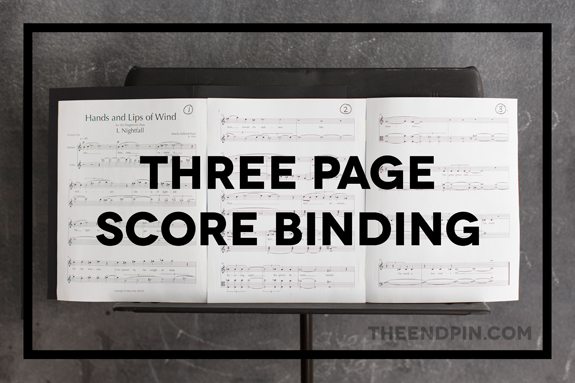
How music fits on a stand is probably my most un-sexy musical interest. A true Type A personality, I find it
very interesting and it absolutely affects my day-to-day music life.
I've had several conversations with composers and performers about score size/orientation, and I thought it might be time to put all of my thoughts in one place.
 (The sizes I'll deal with are the ones you tend to get from composers via pdf. I'm going to ignore 9x12 paper because it's specialty printing. I'll also leave out the standard double 8.5x11 portrait setup. It seems obvious to me that if page turns work out for that size/orientation/number of pages, it's absolutely the best option. I'll also stick to one stand because multiple stands opens up a whole other can of worms. Ok, qualifiers fin)
Spacial Comparison:
Let's start with the most essential analysis - how much music are you actually getting on the stand?
8.5x11 portrait (3 pages per stand) = 290.5
8.5x14 portrait (3 pages per stand) = 357
11x17 portrait (2 pages per stand) = 374
8.5x11 landscape (2 pages per stand) = 187
8.5x14 landscape (1 pages per stand) = 119
11x17 landscape (1 page per stand) = 187
In this comparison, portrait orientation is absolutely the most efficient use of space with 11x17 paper giving you the most space of any paper size.
But stopping there doesn't give you the whole story!
Intangible Comparison:
The size/orientation of music can have unintended effects on the pragmatic experience of making music.
Page Turns: The more music you fit on a stand, theoretically, the fewer page turns you need. This can minimize distracting moments or unwanted sounds during performance, which is especially important as the ensemble gets smaller. (A solo cello piece suffers much more from page turns than an orchestra piece.)
Additionally, page turn difficulty differs instrument to instrument: singers can turn as they need, pianists or some wind instrumentalists can turn when one hand is free, string players can hardly ever turn while playing.
Though it affords more space, page turns can get more complicated or unwieldy with set-ups using 3 pages per stand. The third page often needs to be tucked or untucked during the page turn, which takes additional time.
System Length: Web designers pay a lot of attention to line length and studies show there are optimal lengths for reading ease and comprehension. There are absolutely parallels to reading music - long systems are difficult to read.
Also, the shorter stave systems are, the closer measure numbers are to each other. It seems like an obvious and pointless fact, but infrequent measure numbers mean wasted rehearsal time counting bars. (No, seriously, so much wasted time.) Horizontal page orientations are especially problematic for this reason.
 Overhang:
 Overhang can provide the little extra space on a stand needed to avoid a distracting or difficult page turn. But, large amounts of overhang can result in drooping or falling pages, light issues as stage lights pass through the paper, acoustic interference, and decreased visibility for the audience.
Most of these issues can be fixed with sturdy paper-stock or poster board extensions to the stand, but visibility or acoustics are instrument dependent problems affected by the directional acoustics of the instrument. For example, violinists' music is oriented perpendicularly to the audience, so acoustics and visibility isn't impacted by overhang. On the other hand, a cellists stand is parallel to the audience directly in between the audience and instrument. A huge wall of paper has an acoustic and aesthetic impact.
Another very practical effect of overhang is difficulty writing notes on the score during rehearsal. You can't write easily on any overhang because it isn't supported by the stand. It's obviously a small impact, but worth noting if page sizes with less overhang are an option.
Travel: Large scores are more difficult to transport without damaging them. While 8.5x11 paper easily fits into a protective folder or binder, 8.5x14 and 11x17 paper need to be folded (or risk being crumpled). Why do folds and crumples matter? Besides it being easier to read clean paper, folds and crumples can create shadows under concert lighting or make the music less stable on the stand.
Conclusions:
8.5x11 portrait has the third most space on the stand, minimal overhang, is easy for travel, has a nice system length, and fairly easy page turns. This is always my vote.
A close second is 8.5x14 portrait which has more space on the stand at a cost of slightly more overhang and less convenient travel. I use this set-up frequently as well.
11x17 portrait has the most space on the stand with easy page turns, but is annoying for travel, has long systems, and has inconvenient overhang on the top of the stand. If there are really NO other page turn solutions, this will work out. (Though personally, I'll usually just shrink the music once I know it well enough or write out my own shorthand.)
Landscape orientations are terrible. Really... that's the point of this whole post. Please don't use them. Like, ever.
Did I miss something? Have another reason for or against a certain paper set-up? Let me know in the comments