9.9.14

Knitting Vs. Sculpting

How does the saying go? "There are two kinds of people in the world: those who divide the world into two kinds of people, and those who don't" – Robert Benchley

Knitting Sculpting Title

Well, today I'm going to fall into the former category along with Karl Paulnack, dean of the School of Music at Ithaca College. I met him when he was the Director of the Music Division at Boston Conservatory, and he taught me a metaphor I've been using ever since.

You're Either a Knitter or a Sculpter

Knitting Sculpting_3

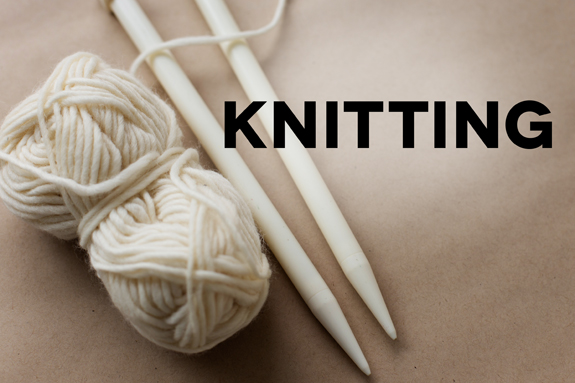
Knitting is a step-by-step process. Each stitch must be perfect before the knitter can move on, and mistakes cause ripple effects out into the rest of the work. Knitters can't to skip to the end or bounce to another part of the project, they work one stitch at a time until they're finished.

Workers who are "knitters" start at the beginning and deal with each section or obstacle as it arises. In music, these are the people who learn rehearsal A before they can go on to B. They perfect the first phrase before dealing with the next and are inclined to start the metronome at its lowest setting, working their way click by click to the final tempo. They thrive on detail and the micro-level.

At their worst, the knitter is all nuance and no vision, or can't find their way to the end a project. At their best, they're the master of detail and patience.
Knitting Sculpting_2

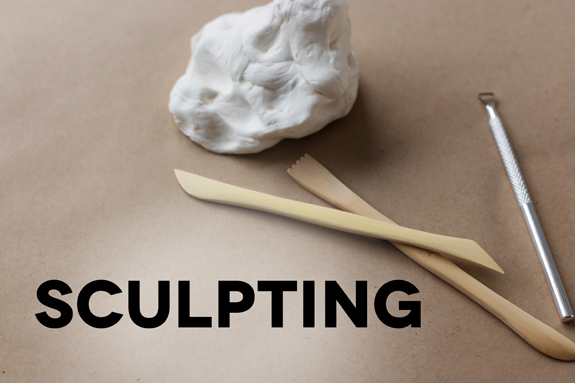
Sculptors begin with a chunk of clay or rock. From the whole, they slowly chip away, forming details layer by layer. They move around their medium, revealing the whole as they refine the edges of their work. Working on one section without stepping back to examine the whole results in distortions and imbalances, so the sculptor always has their eye on the gestalt.

Workers who are "sculptors" begin each project with an overview to evaluate all challenges and get a sense of the final result. In music, they're likely to play through a piece, deal with small issues, then run through the piece again to see how their solution fit into the larger context. They drill down from the whole into its details and always place musical elements in a large scale.

At their worst, sculptors are full of grand gestures without the substance to back them up, or they end up with a sloppy final product. At their best, they're masters of form and vision.

Knitting Sculpting_4 small

In reality, none of us are only knitters or only sculptors - we land somewhere in between, but might lean one way or the other. Depending on what's being asked of us or what phase of a project we're in, we might switch between the two styles.

But, because music is so often collaborative, it's still helpful to know which way you lean. For example, I'm almost always a knitter, so, left to my own devices, I'll drill a detail into the ground until. It. Is. Perfect. That's fine in my personal practice, but can be soul-sucking for my sculptor collaborators. I'm always careful to keep an eye out for the glazed over "can we PLEASE move on!" look from my partners in music - that's when I know it's time to switch to sculpting!

Being aware of my penchant for knitting is also helpful when I start new projects. I know if I need to learn a piece of music quickly, I might not have time to knit - if I do, I'll probably sound rough at the end of the piece. Instead, I know I'm going to have to let go of a few details and spend some time sculpting.

In the end, it's best to be able to knit and sculpt, and either method can be learned with a little targeted effort. Both styles are useful in different settings, and both end in beautiful art.

So which are you? Knitter or sculpter?

2.9.14

Three Page Score Binding

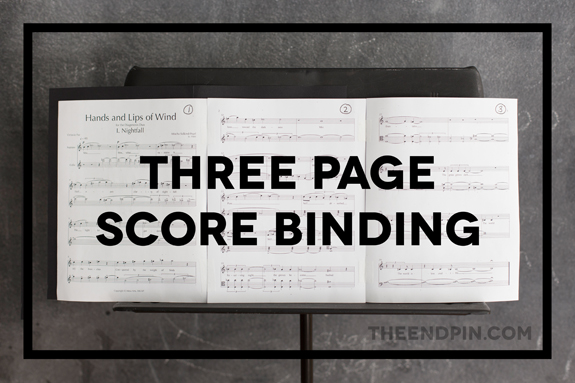
Any musician playing from photocopies or printed PDFs will rapidly outgrow the basic score binding method. Many pieces simply do not include rests for page turns! In those cases, having three pages on the stand may be the best solution.

Three Page Binding Title

I remember the first couple of times I attempted to assemble my own trifold scores. Assembling a score with trifolds isn't hard, but I managed to make a few very awkward scores before I ironed out the kinks to my method.

So that you can skip past the awkward score phase (think of it as the teen years of do-it-yourself score binding), I've made a video tutorial that will teach you exactly how to add a third page to your scores. As a bonus, there's also an alternative trifold page turn solution that can save you paper.


See? Totally doable and very handy!

If you're a performer who likes to invest in spiral binding for their scores, you can still have trifolds. Just trim about 1/4 inch off the edge of your trifold page, so it can be tucked in without bumping into the spiral binding.


If you have any score binding questions, requests, or additional tips be sure to leave them in the comments!

26.8.14

The Illusion of Ease

Ease and effortlessness are essential to so much creative work. From an effortless bow change to an oil painting that masks all brush strokes, ease allows other emotions, characteristics, ideas, and experiences to hold central focus.

But ease is almost always an illusion.

Illusion of Ease Title

For example, I started The Endpin in May, 2014. To a visitor it might look as if I were able to launch a blog with a custom design, publish posts that have been widely shared (PS thank you for that!!), use original photography, and cover a variety of relevant topics in four months.

In reality, I've blogged about other topics for 5 years, I've taken e-courses on blogging, I've learned rudimentary web design over about 5 years, and my first blog looked like crap. I've steadily improved my photography over 4 years, I've been interested in and actively studying graphic design for about 3 years, and I've worked part-time as UCSD Music Department's Promotions Graphic Designer for 2 years. I thought about starting a music blog for ages before deciding I had information worth sharing, then I journaled blog topic ideas for several months before writing my first post. Each post is based on an idea I've considered at length (sometimes for years) and can take anywhere from 3-14 hours to photograph, write, and edit.

Illusion of Ease small

I don't want readers to feel my efforts because it would distract from the point of my posts. (And this post is absolutely not to show off how hard I work - the cult of "I am so busy" ISN'T the solution to the illusion of ease.) But, it's important to know that my work isn't the result of a first try. I've experimented with, learned about, mulled over, and (to be honest) failed at so many things to get to this point.

If someone else were interested in creating a similar blog, it would take a similar amount of effort and accumulated experience.

Working towards our creative goals is hard, and when we buy into the illusion of ease we risk inviting floods self-doubt and criticism into our creative processes. While self-doubt and criticism are completely unavoidable - they're feelings every artist learns to manage over time - they become problematic when the feelings are so consuming that they overwhelm our efforts. We quit.

Ira Glass articulates it beautifully in this interview by Current TV
(animated by David Shiyang Liu).


Understanding that, as a rule, good things take effort normalizes the effort each of us experience when we try something new. If we know that achievement takes time, no matter how easy it looks, we can move from "I'm not good at ___" to "I'm not good at ___ YET"

Grappling with the illusion of ease means holding two truths simultaneously. We must both experience creative works as they're intended (usually without a projection of effort) AND cultivate an understanding of the effort all creative endeavors require.

19.8.14

8 Free Resources for DIY Websites

Website Resources Header

Generally, life as a musician is built on a shoestring budget. And, while there are many affordable website design options out there, nothing beats free. Below are the 8 Customizable, High Quality, and FREE Resources I personally use to create my cello website.

Free Service Images blogger

1. Blogger

Yes, it's designed as a blogging platform, but I've found blogger to be so easy to customize that I love using it for my website. An added bonus, its massive user base has resulted in an endless supply of tutorials. If you'd like to do something with it, there are probably detailed instructions out there already. An additional advantage is that, since it's hosted by Google, blogger servers rarely if ever go down - you won't have to worry about your website breaking.

See it in action || Other options: Wordpress

Free Service Images flickr

2. Flickr

If you'd like to add images to your website (and you probably should), you'll need a service to host them. While, there are many many options out there, I use flickr because it maintains the high quality of my photos and is so easy to use.

Other options: Photobucket, Picasa (Google+)

Free Service Images dropbox

3. Dropbox

If you'd like allow visitors to access files on your website (maybe an EPK, different versions of your bio, or free downloads), Dropbox is an easy file hosting service. Also, if you're managing a website with others (say, as part of an ensemble), Dropbox is build to be easily sharable and collaborative.

Other options: Google Drive

Free Service Images youtube

4. YouTube

Ubiquitous on the internet, YouTube is my go-to host for videos. It used to have a lower visual quality than Vimeo, but has massively improved in recent years. The added bonus of a very active community (don't read the comments though!) makes this my preferred video resource.

See it in action || Other options: Vimeo

Free Service Images soundcloud

5. SoundCloud

To be honest, I haven't delved completely into everything soundcloud has to offer, but I love that you can customize the embeddable audio player to blend seamlessly into your web design.

See it in action || Other Options: Bandcamp

Free Service Images calendar

6. Google Calendar

Most musicians create their online calendar by simply adding text to a webpage, but I find that very difficult to update - I always forget! For me, the best solution is to embed a google calendar (which I already used for all of my scheduling) into my website. When I add a calendar to my personal account, it automatically updates my website. This solution has the added bonus of doubling as a "Past Concerts" page.

See it in action

Free Service Images mailchimp

7. MailChimp

When I first started using MailChimp for my newsletters, I really appreciated how easy it was to use. Even more impressive (though admittedly not quite as easy) is how seamlessly I can embed the MailChimp newsletter sign up form onto my website. It's practically impossible to tell it's an external service at all!

See it in action

Free Service Images analytics

8. Google Analytics

I use Google Analytics to learn how to improve to my website. From how many people visit to where they come from, having a good analytics system in place helps me decide where to effectively invest my efforts.

By no means breaking news, together these free services provide me with everything I need to have a self sustaining web presence. If you have other services you use and love, please leave them in the comments below!